Anion Gap Calculator for Medical Interpretation
An anion gap calculator assists medical professionals and learners efficiently analyze electrolytes from a BMP or serum chemistry panel. The result is a small but powerful clue in lab interpretation, especially when considering metabolic acidosis, mixed acid-base patterns, and other forms of electrolyte imbalance. Because the anion gap shows the relationship between major measured ions, it can suggest the presence of unmeasured anions and inform a more focused clinical evaluation.
Used correctly, the anion gap calculator is not just a simple arithmetic tool. It enhances acid-base balance assessment, helps identify an anion deficit or acid excess, and improves the interpretation of blood test results in a wide range of situations. Understanding the underlying anion gap formula and the role of albumin makes the result far more meaningful than the raw number alone.
What the Anion Gap Measures
The anion gap is an indirectly calculated estimate derived from routine electrolytes. It compares the main positively charged ions, particularly serum sodium, with the main negatively charged ions, especially serum chloride and bicarbonate. Because standard lab panels do not measure every ion in the blood, the gap gauges the difference between measured cations and measured anions, offering a clue about unmeasured anions in the bloodstream.
In practical terms, the anion gap serves as a diagnostic tool that can point to hidden acids or uncommon lab abnormalities. It is particularly useful when assessing a metabolic disorder involving acid accumulation. When the gap is elevated, it often points toward added acids or retained acids. When the gap is low, it may suggest a loss of albumin, analytical error, or unusual proteins affecting the result.
The most common values used in the calculation come from a standard electrolyte panel. In many cases, serum sodium, serum chloride, and serum bicarbonate are enough to estimate the gap. Some formulas also include serum potassium, though that version is less commonly used in everyday clinical practice. The result is not a diagnosis by itself, but a starting point for more targeted medical assessment.
Because the anion gap is tied to serum chemistry, the result should always be interpreted with the rest of the panel and the patient’s presentation. A number that looks abnormal may be clinically important, but it may also reflect a lab abnormality or a shifting physiologic state. That is why the anion gap is best used as part of a broader interpretation guide, not in isolation.
How the Anion Gap Calculator Works
An anion gap calculator uses the anion gap formula to the laboratory values input into it. In its plainest form, it subtracts chloride and bicarbonate from sodium, and in https://anion-gap-app937.raidersfanteamshop.com/anion-gap-calculator-for-medical-interpretation some versions potassium is included as well. The calculation is quick, but its value comes from how it supports real-world clinical evaluation.
The calculator typically asks for serum sodium, serum chloride, serum bicarbonate, and sometimes serum potassium. These are standard lab values from the basic chemistry panel. Once submitted, the calculator provides an estimated gap that can be compared with the expected reference interval or local reference range. That comparison helps determine whether the result is typical, elevated, or decreased.
In practice, the tool is most useful when a clinician is evaluating possible metabolic acidosis. A high gap may suggest excess acids that are not routinely measured. A normal gap in the setting of acidosis may indicate a different process, such as bicarbonate loss with compensatory chloride retention. This makes the calculator a helpful screening utility for acid-base problems.
The calculator does not replace judgment. A single number cannot distinguish all causes of acid-base abnormalities, and it cannot interpret the whole picture without context. Still, it improves diagnostic accuracy by organizing the available data into a clinically meaningful framework. That is why it is so often used during medical assessment of suspected acid-base disturbances.
Anion Gap Formula and Calculation Steps
The standard formula used for calculation is:
Na minus Cl minus HCO3
In this case, Na stands for sodium, Cl represents chloride, and HCO3 represents bicarbonate. Some clinicians also use a version that includes potassium. The method is similar, but the result will vary a little depending on whether potassium is included. For typical interpretation, the sodium-chloride-bicarbonate version is the standard formula for calculation.
To carry out the calculation, beforehand collect the necessary lab measurements from the electrolyte panel. Then insert those values into the formula. For instance, if sodium is 140, chloride is 102, and bicarbonate is 24, the value would be 140 minus 102 minus 24, which is 14. That number can then be compared with the expected normal range or regional reference range.
Serum albumin plays a role because it is a major unmeasured anion. If albumin is reduced, the measured gap may appear falsely low or normal even when pathology is present. In those situations, a corrected anion gap may provide a more accurate calculation. This correction helps account for the effect of reduced protein on the observed gap.
A short sample calculation can demonstrate the benefit of adjustment. Imagine the original gap is unremarkable, but the patient has significant hypoalbuminemia. Following correction for albumin, the corrected value may show a hidden elevation. That difference can affect the interpretation from apparently normal chemistry to a clinically relevant acid-base disorder.
It is not enough to simply memorize the formula but to comprehend what the number means. The gap indicates the balance of measured ions versus unmeasured anions, which is why it remains valuable in identifying acid accumulation and other hidden processes. The calculator streamlines the arithmetic while maintaining the clinical meaning.
Standard Anion Gap Ranges and Interpretation
The normal range for the anion gap depends on the laboratory method and whether potassium is included. Because methods vary, clinicians should use the NAGMA causes local reference range rather than relying on a single universal number. This is one reason the result should be interpreted alongside the specific laboratory system used for the test.
A high anion gap typically suggests the presence of additional acids or retained acids in the blood. A decreased anion gap, while less common, can also be clinically important. In either case, the number should prompt a careful review of the patient’s symptoms, medications, underlying diseases, and the rest of the electrolyte panel.
Understanding the result requires a structured approach. If the gap is high, think about acid accumulation and disorders that produce unmeasured acids. If the gap is low, consider whether the result reflects reduced albumin, paraproteins, or a technical problem. A careful review of the full test interpretation often prevents missed diagnoses.
It is also important to remember that a “normal” result does not automatically mean there is no acid-base problem. Some disorders produce a normal gap despite obvious acidosis. Others may cause mixed patterns that obscure the expected change. The anion gap is a useful clue, but it is only one part of the larger clinical picture.
Sources of High Anion Gap Metabolic Acidosis
A key use of the anion gap is identifying metabolic acidosis with a high anion gap. This finding often suggests that acids have accumulated at a rate the body cannot keep up with. The elevated gap reflects the presence of unmeasured anions that are not readily visible on routine testing.
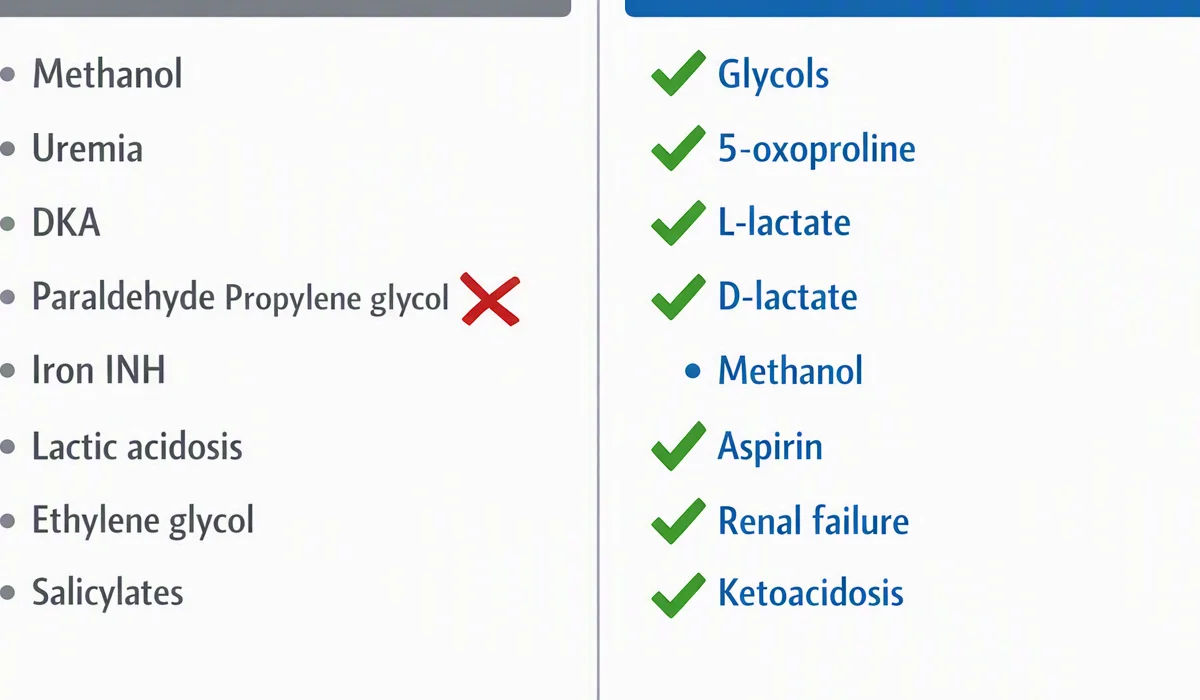
Lactic acidosis is a classic cause. It develops when lactate rises because of tissue hypoperfusion, severe illness, shock, seizures, or impaired oxygen delivery. In this setting, the increased acid load raises the gap and may signal a medical emergency. The anion gap calculator can rapidly suggest further evaluation when lactate-related acid accumulation is suspected.
Ketoacidosis is another major cause. It may occur in diabetes, prolonged fasting, alcohol-related states, or other conditions that increase ketone production. Ketones are acid byproducts, and when they accumulate, the gap rises. A high gap in this setting often fits the overall clinical picture of worsening acid-base balance and volume depletion.
Renal failure can also produce a high gap because the kidneys are inadequately able to clear acid and other solutes. As kidney function declines, retained acids build up and contribute to metabolic disturbance. In this situation, the anion gap helps show the burden of retained metabolic byproducts and supports the broader assessment of renal-related illness.
There may be other causes, but these three are among the most common and clinically important. The key point is that a high gap should prompt a search for the underlying reason, rather than being treated as a result in isolation. The value is a clue to a metabolic disorder, not the final answer.
Sources of a Reduced Anion Gap
A low anion gap is less common than a high one, but it can be a meaningful finding. One of the leading explanations is hypoalbuminemia, since albumin is a major unmeasured anion. When albumin falls, the measured gap may fall too, even if no new pathology is present. This is why albumin should always be taken into account in the interpretation.
Multiple myeloma is another significant cause. In this condition, abnormal immunoglobulins can disrupt the balance of charged particles in the blood. Related to this is paraproteinemia, where excess abnormal proteins shift the measured relationship between cations and anions. These conditions may produce a low gap and warrant attention when the pattern is unexplained.
Laboratory error is also a regular possibility. Because the gap is derived from several measured values, an error in any one component can distort the result. A questionable low gap should prompt a repeat test and a review of the underlying lab values. Sometimes the simplest explanation is an issue with sample handling or measurement rather than true physiology.
Other contributors can include abnormal electrolyte states or analytical interference, but the most important first steps are to check albumin, consider paraproteinemia, and confirm the result. A low number should not be ignored, especially if the patient has symptoms or a known plasma cell disorder. It may be the initial sign to a significant abnormality.
When to Use Albumin Correction
Serum albumin should be measured whenever the anion gap seems out of sync with the clinical scenario. Because albumin contributes substantially to the body’s net negative charge, low levels can conceal an elevated gap. In those cases, albumin correction can reveal a more accurate corrected value and lower the risk of misinterpretation.
The logic behind anion gap correction is driven by protein binding and the charged nature of albumin. When albumin drops, the measured gap may fall even if the patient has ongoing acid accumulation. Correcting for albumin helps account for this shift and makes the result more clinically useful.
Albumin correction is especially useful when evaluating critically ill patients, people with liver disease, malnutrition, or inflammatory states. In these cases, standard interpretation may underestimate the seriousness of the acid-base disorder. A corrected gap can improve the diagnostic utility of the calculator and aid more appropriate next steps.
That said, correction should be used carefully. It is a tool to improve interpretation, not a substitute for broader clinical context. If the patient has a clear acid-base abnormality, the corrected and uncorrected values should both be considered with other findings.
Clinical Use Cases and Limitations
The anion gap is most helpful in evaluating an acid-base disorder, especially suspected metabolic acidosis. It also helps identify broader electrolyte imbalance patterns and can point the clinician toward a narrower differential diagnosis. Because it is easy to calculate from routine testing, it remains a practical part of daily clinical evaluation.
One important use case is the interpretation of an arterial blood gas together with serum chemistry. A blood gas may show acidemia or alkalemia, while the electrolyte panel and anion gap help explain the cause. Together, these tests give a more complete view of acid-base balance than either test alone.
However, the anion gap has drawbacks. It does not reveal the exact acid responsible for the problem, and it may overlook mixed disorders. A patient can have a normal gap and still have significant acidosis. In addition, changes in albumin, measurement methods, and lab technique can all affect the result. That is why careful lab interpretation depends on the overall clinical context.
When used properly, the gap offers solid screening utility and helpful diagnostic accuracy. It can signal a serious problem early, guide further testing, and help prioritize treatment. But as with any medical assessment, the number must be interpreted with the history, exam, medications, kidney function, and other blood test results.
In short, the anion gap calculator is most valuable when it supports a complete diagnostic process. It helps convert raw chemistry into a meaningful assessment of acid-base balance and metabolic disease. The key is not just computing the number, but understanding what it means in real practice.
Frequently Asked Questions
What is an anion gap calculator used for?
An anion gap calculator is used to efficiently calculate the anion gap from routine lab values and help with lab interpretation. It is commonly used as a medical calculator to assess metabolic acidosis, identify possible acid accumulation, and support interpretation of an electrolyte panel or serum chemistry result.
How do you calculate the anion gap from lab values?
The usual anion gap formula is Na minus Cl minus HCO3, using serum sodium, serum chloride, and serum bicarbonate. Some versions also include serum potassium. Enter the values into the calculator or apply the formula manually, then compare the result with the local reference interval.
What is a high anion gap indicate medically?
A elevated anion gap often indicates metabolic acidosis due to added acids or retained acids in the blood. Frequent causes include lactic acid accumulation, ketoacidosis, and renal insufficiency. It may indicate the presence of unaccounted anions and should be considered in the overall clinical context.
Why is albumin correction important in anion gap interpretation?
Albumin is a major unmeasured anion, so low albumin can make the gap appear decreased than it truly is. The albumin adjustment helps estimate a more precise albumin-corrected gap. This improves the chance of detecting hidden metabolic abnormalities and makes the result more trustworthy for medical evaluation.
Is it possible for a normal anion gap still occur with metabolic acidosis?
Yes, it can. A normal anion gap can still be seen with some types of metabolic acidosis, especially when bicarbonate loss is matched by chloride increase. It can also occur when albumin is low or when a mixed disorder is present. That is why the anion gap should always be evaluated with the patient’s overall presentation, not as a standalone answer.